
Christmas is a perfect opportunity to give more than just toys: it’s the ideal time to choose educational gifts that stimulate your children’s creativity, curiosity and critical thinking. In a world full of screens and fast-paced consumption, schools Best Schools in Spain (BSS) are committed to a more conscious approach to learning, where every game or activity becomes an opportunity to explore, discover and grow.
This guide introduces you to 15 educational gift ideasorganized by age, that combine fun and learning, following the pedagogical philosophy that drives BSS schools: active learning, creativity, family projects and purposeful experiences.
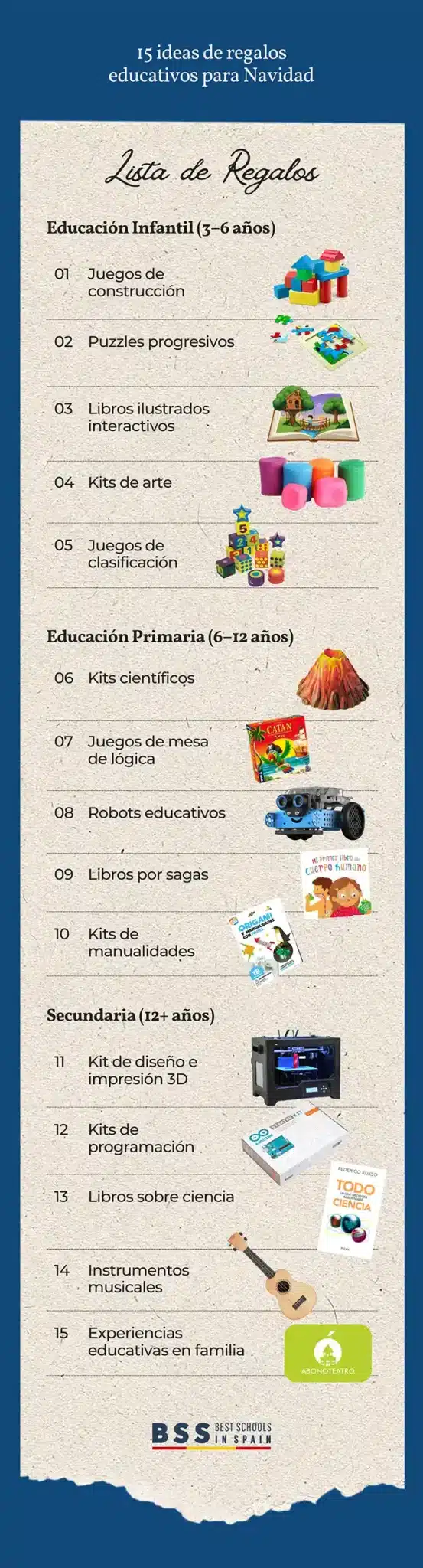
Educational gifts by age
Early Childhood Education (3-6 years)
Key stage for sensory development, creativity and fine motor skills. Here, the main thing is to play, experiment and discover.
1. Building sets (large blocks or magnetic blocks)
They develop motor skills, logic and creativity.
- LEGO® Duplo LEGO® Duplo,
- stackable wooden blocks,
- magnetic tile-like pieces to build houses, cars or figures, like this one from Clear Colors
2. Progressive puzzles with few pieces
Ideal to work on concentration and visual perception.
- Puzzles from 12, 24 or 36 pieces with animal, world map or profession themes,
- puzzle sets with various difficulties in the same set (to grow with the child).
3. Interactive picture books
Stories with flaps, textures or sound buttons.
- Tales of emotions,
- first illustrated atlases,
- books with “search and find“to develop observation and vocabulary.
Art kits for small hands
Encourage creativity and expression.
- Soft Plasticine with large tools,
- washable tempera crayons from Crayola,
- thick-tipped markers + large pads of paper,
- sets for stamping with foam stamps. stamps.
Classification and seriation games
Introduce basic mathematical concepts.
- Bears or colorful figures for counting and grouping,
- trays with pieces of different shapes to sort by size or color,
- sets of stringing large beads on strings.
At Best Schools in Spain, the Infant stage is filled with symbolic play, art and logic corners where children experiment with materials, classify, build and tell stories. These types of gifts are very similar to classroom proposals: open-ended, creative and highly manipulative games.
Primary Education (6-12 years)
An ideal stage to introduce STEAM skills, autonomous reading and games that emphasize logic and teamwork.
6. Science kits for first experiments
Perfect for awakening a passion for science.
- kits to assemble a volcano and understand chemical reactions,
- sets of children’s microscope with prepared samples,
- basic electrical experiments (simple circuits, light bulbs, switches). (simple circuits, light bulbs, switches).
Logic and strategy board games
They work on planning, memory and critical thinking.
- Chess or checkers with an attractive board,
- games type Rush Hour, Junior Catan, Dixit, Dobble,
- cooperative games where everyone wins if they solve the challenge together.
8. Educational robots for beginners
9. Books by sagas or thematic collections
Reinforce the reading habit.
- adventure sagas adapted to their age, we leave you with this post where you can see our post where you can see our reading recommendations according to age..
- science collections explained for children,
- books of curiosities of the human body, space, animals or history.space, animals or history.
10. Advanced craft kits
Improve patience, fine motor skills and creativity.
- Sets of origami,
- kits for making bracelets, key chains or beads,
- creative recycling projects (building toys or models from cardboard, old clothes, etc.).
Many BSS schools organize science fairs, book clubs and art projects where students research, experiment and present their work. These gifts are a perfect fit for such activities: they encourage the critical thinking, scientific curiosity and independent reading that is taught in primary school.
Secondary (12+ years)
A stage in which adolescents seek autonomy, real projects and tools that connect with their interests.
11. 3D printing and design kit
Ideal for teenagers interested in technology and design.
- 3D printer Basic domestic (shared in family),
- 3D pens to create figures,
- simple 3D modeling software to design your own objects.
12. Programming and electronics kits
They connect with the STEAM approach of many BSS schools.
- Arduino® type boards Arduino® or or similar with guided projects (traffic lights, sensors, LED lights),
- robotics kits that combine construction type parts + motors + programming app. Kits such as Arduino Starter Kit y Raspberry Pi are excellent options,
- small home automation projects (turning on lights, motion sensors, etc.).
13. Books on science, creativity or critical thinking
Suitable for young people, not academically dense.
- Biographies of inventors, scientists or entrepreneurs,
- books that explain physics, economics or technology with everyday examples,
- essays on social networks, artificial intelligence or sustainability adapted to teenagers.
14. Musical instruments for beginners
They promote discipline, concentration and artistic expression.
- Ukulelekeyboard or drum machine,
- simple interfaces to create digital music on your computer or tablet,
- initial online classes combined with the instrument.
15. Family educational experiences
Gifts that don’t go on a shelf, but in memory.
- Entrance fees to science or art museums with guided tour,
- workshops on ceramics, robotics, cooking or photography,
- cultural getaways (historical cities, literary routes, visits to observatories, etc.).
For this type of gift, we recommend SubscriptionTeatroa fantastic option for year-round access to plays, shows and cultural activities. It is a gift to be enjoyed as a family, which boosts artistic sensitivity and fits perfectly with an education based on curiosity, critical thinking and shared culture.
In secondary schools, BSS schools promote robotics projects, innovation labs, theater groups, music and cultural outings. Gifts such as programming kits, instruments or experiences like AbonoTeatro reinforce exactly this type of active and global learning that they experience in their daily school life.
How to choose educational gifts with real educational value
For a gift to be truly educational, it must meet at least one of these principles:
- Develop a specific skill: Creativity, logic, language, motor skills, autonomy or digital skills.
- Encourage active learning: It involves experimenting, not just observing. Let the child be the protagonist.
- Accompany real interests: If he likes music, encourage it. If he’s passionate about science, offer him challenges.
- Prioritize quality over quantity: One good educational gift has more impact than several purposeless toys.
- Allow family play: BSS schools promote activities where learning is shared: board games, joint reading, experiments or creative projects.
The BSS approach: learning that transcends the classroom
The Best Schools in Spain schools include in their day to day activities such as:
- logic games and critical thinking,
- science projects and STEAM challenges,
- book clubs,
- artistic and musical workshops,
- experiences that connect curiosity and learning.
This approach also inspires the selection of gifts at home: proposals that accompany the development of each child and stimulate his or her natural talents.
Conclusion
This Christmas, giving the gift of education is giving the gift of the future.
Toys and activities with purpose accompany children in their emotional, cognitive and creative development. Betting on educational gifts means supporting their curiosity, strengthening their learning and building meaningful family moments.
If you want to find out more about how students learn in BSS schools:
👉 Explore the best private schools by province
👉 Discover our BSS schools
👉 Contact us if you need advice

Frequently Asked Questions
What is an educational gift?
An educational gift is a game, book or activity designed to stimulate skills such as creativity, logic, language or STEAM competencies, encouraging learning through play.
Why give educational toys for Christmas?
Because they combine fun and learning, awaken children’s natural curiosity and contribute to their overall development, especially during the vacations.
What kind of educational gifts do BSS schools recommend?
BSS schools recommend logic games, science projects, creative materials, age-appropriate books and cultural experiences for the whole family to enjoy.
What educational gifts are best for primary school children?
For primary school, science kits, strategy games, educational robots and books that reinforce curiosity and logical thinking are ideal.
What educational gift is suitable for teenagers?
For teenagers, we recommend programming projects, 3D printers, inspiring books or cultural experiences that stimulate their critical and creative thinking.
Do educational gifts replace free play?
No. Educational gifts should complement free play, not replace it. The balance between creativity, spontaneous play and learning is key to healthy development.
What should I consider when choosing an educational gift?
It is important to consider the age, the child’s interests, the quality of the material and whether the gift encourages active and meaningful learning.