

Artificial intelligence and children, a combination increasingly present in the daily lives of families. The AI-based tools are already part of search engines, educational applications, voice assistants, video games or even study platforms used by children and teenagers. Faced with this new scenario, a key question arises: How can we help our children to use artificial intelligence in a responsible, critical and educational way?
Schools with seal Best Schools in Spain (BSS) work on this challenge from a clear vision: AI should not replace thinking, but rather enhance learning, creativity and autonomy. learning, creativity and autonomy of the student. learning, creativity and autonomy.
Artificial intelligence is already at home (even if we are not always aware of it).
Many children use tools with artificial intelligence without identifying it as such. From systems that recommend content, applications that correct exercises, automatic translators or assistants that answer questions, AI has been naturally integrated into everyday technology.
The challenge is not to avoid using it, but to understand how it works and learn to use it judiciously. Just as we teach how to read critically or surf the Internet safely, responsible digital education must include the conscious use of artificial intelligence.
Main risks of unaccompanied use of AI
In the absence of adequate guidance, the use of AI can generate some real risks:
Technological dependence
If the child uses AI to solve tasks without understanding the processes, the child’s reasoning ability and personal effort are reduced.
Lack of critical thinking
AI offers quick answers, but not always correct, complete or adapted to the context. Accepting them without question limits the development of one’s own judgment.
3. Unawareness of biases and errors
AI tools may contain biases, errors or outdated information. Understanding that they are not “foolproof” is key.
4. Privacy and fingerprint
Many apps collect data. Teaching children how to protect their personal information is an essential part of digital literacy.
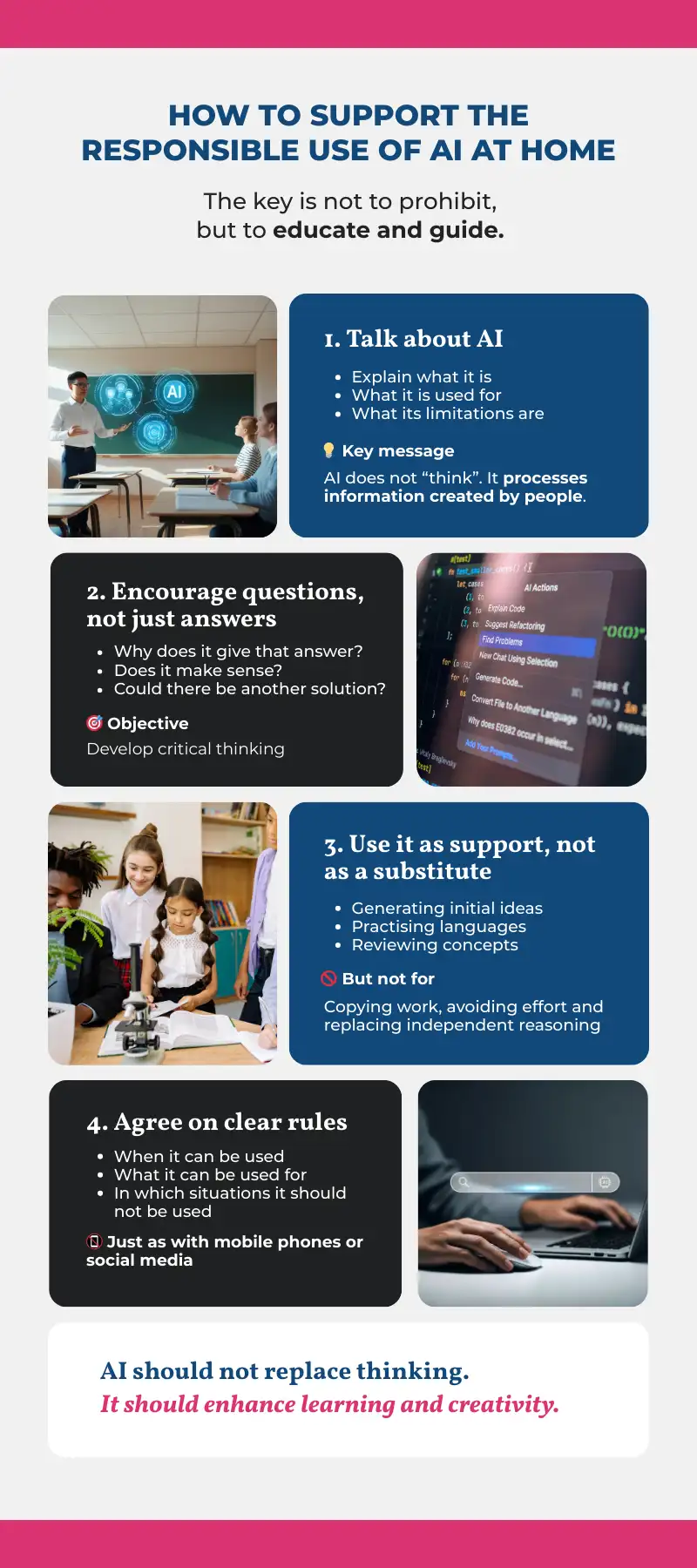
How to support the responsible use of AI from home
Families play a fundamental role. Some practical guidelines are:
Talking openly about AI
Explain what it is, what it is for and what its limits are. AI does not “think”: it processes information created by people.
Encourage questions, not just answers
Encourage children to question what the AI is proposing: Why does it give this answer, does it make sense, could there be another solution?
Use it as a support, not as a substitute
AI can be used for:
- generate initial ideas,
- practice languages,
- review concepts,
but not to avoid effort or copy work.
Agree on clear rules
Define when and what AI can be used for, just as you do with other technologies at home.
The BSS schools approach: responsible digital education
The Best Schools in Spain schools integrate artificial intelligence within a solid pedagogical framework. It is not a matter of introducing technology for fashion, but of to train critical, creative and autonomous students.
The most common practices include:
Digital literacy from an early age
Students learn how digital tools work, how to evaluate information and how to protect their online identity.
Ethical and conscious use of AI
We work on concepts such as:
- authorship and originality,
- limits to the use of AI in academic work,
- reflection on the social and ethical impact of technology.
Active learning and projects
AI is used to support research, programming, robotics or creativity projects, always encouraging the student to be the protagonist of the process.
Continuous teacher training
Teachers receive specific training to integrate AI in a responsible way, aligned with the school’s educational values.
AI, creativity and critical thinking: an educational opportunity
Used well, artificial intelligence can be a great ally of learning. It helps to personalize the educational pace, stimulates curiosity and allows to explore new ways of creating and learning.
The goal is not for children to “know how to use AI,” but for them to learn to think in a world where AI exists. Learn to think in a world where AI exists. This is one of the keys to the educational model promoted by BSS schools.
Conclusion
The coexistence between artificial intelligence and children is already a reality. Accompanying them in their responsible use does not imply prohibiting, but rather educating, dialoguing and setting limits with meaning. When families and schools work together, AI becomes a learning tool, not an empty shortcut.
If you want to know how BSS schools integrate technology with pedagogical criteria and a vision of the future, we invite you to explore our private schools and their educational project.
👉 Explore the best private schools by province
👉 Discover our BSS schools
👉 Contact us if you need advice

Frequently Asked Questions
What is the relationship between artificial intelligence and children today?
Artificial intelligence is present in many digital tools that children use on a daily basis, such as educational applications, search engines, virtual assistants and learning platforms. It is part of today’s technological environment.
Is it dangerous for children to use artificial intelligence?
No, as long as there is adult accompaniment and educational guidance. The risk is not AI itself, but its use without guidance, without clear criteria and without the development of critical thinking.
How can schools teach responsible use of AI?
Schools can promote responsible use through digital literacy, hands-on educational projects, ethical reflection and clear rules on the academic use of artificial intelligence.
Can AI replace traditional learning?
No. Artificial intelligence should be a support for learning, never a substitute for learner effort, reflection, deep understanding or creativity.
At what age can you start talking about AI with children?
From an early age, adapting the language to their level of understanding. Understanding how technology works is part of basic digital education.
What guarantees the BSS schools approach?
BSS schools guarantee a responsible integration of technology, oriented towards critical thinking, digital ethics and the integral development of the student.