

Children and screens is one of the most worrying issues for families today. Tablets, cell phones, computers and video games are part of the daily life of children and adolescents, both at home and at school. The question is no longer whether they should be used, but whether they should be used at all. how, how much and for what especially in an increasingly digitalized educational context.
Finding a healthy balance between technology and learning is possible if the uses are well differentiated, clear limits are established and children are accompanied with judgment. This is also the approach followed by Best Schools in Spain (BSS) where technology is integrated as a pedagogical tool, not as an end in itself.
Passive consumption vs. active learning: the key difference
Not all screens are the same, nor do they generate the same educational impact.
Passive consumption
It is the one in which the child:
- only receives stimuli,
- does not make decisions,
- does not reflect or believe.
Common examples:
- chained videos with no objective,
- repetitive games without cognitive challenge,
- prolonged use of social networks without supervision.
This type of consumption, when excessive, can affect attention, rest and school motivation.
Active learning
Here technology is used to:
- research,
- create,
- solve problems,
- communicate,
- reflect.
Examples:
- digital projects,
- programming,
- robotics,
- oral presentations supported by digital tools,
- guided use of educational platforms.
BSS schools prioritize this second approach, integrating technology within active methodologies and with clear objectives.
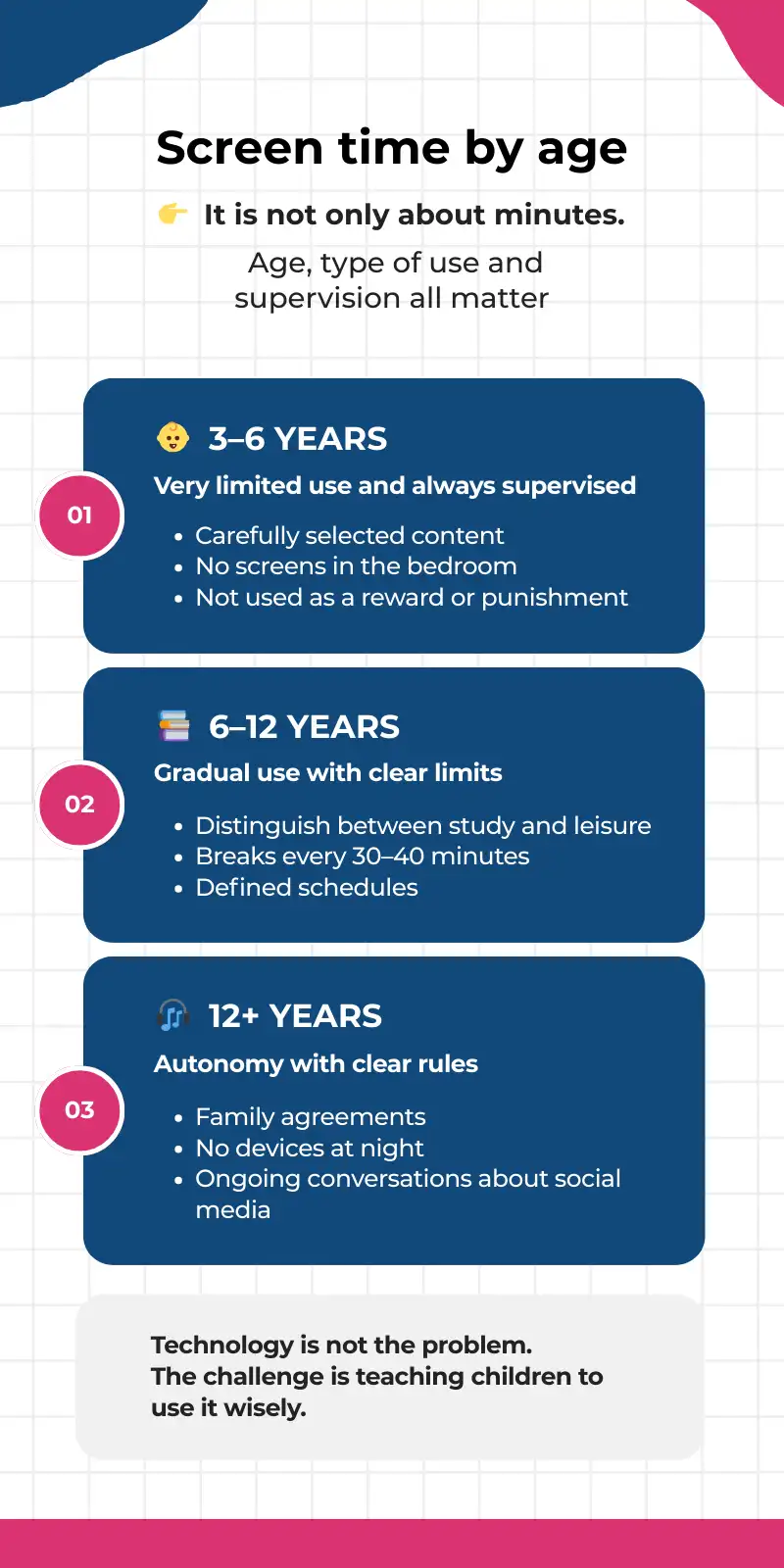
How much screen time is reasonable according to age
Rather than counting minutes in a rigid way, it is important to to adapt the use to the educational stage:
Children (3-6 years)
- Very limited use and always accompanied.
- Screens as occasional support, never as main entertainment.
- Absolute priority to physical, symbolic and creative play.
Primary (6-12 years)
- Progressive introduction of technology for educational purposes.
- Short times and breaks.
- Differentiate clearly between school use and digital leisure.
Secondary and adolescence (12+ years)
- Greater autonomy, but with clear rules.
- Accompaniment in the use of social networks and video games.
- Promotion of self-control and time management.
At all stages, the adult example adult example is key: rules work best when they apply to the whole family.
Practical tips for setting healthy limits at home
Talking about limits does not mean prohibiting. Some concrete guidelines that work are:
Define what the screens are used for
It is not the same thing:
- using the computer for school work,
- than using the cell phone without a target for hours at a time.
Naming the use helps to raise awareness.
Create clear digital routines
For example:
- no screens during meals,
- devices outside the bedroom at night,
- daily disconnection times.
Accompanying and conversing
Inquire:
- what they are seeing,
- what they are interested in,
- what surprised them.
Conversation reduces risks and fosters critical thinking.
Alternate with non-screen activities
Sports, reading, music, board games and creative activities should continue to play an important role in their daily lives.
How BSS schools work on digital balance
The BSS schools understand that digital education must be responsible, progressive and responsible, progressive and pedagogical. Some of their usual practices are:
Project-integrated technology
Digital tools are used within real projects, not in isolation. The student researches, creates and presents results.
Development of critical thinking
They are taught to question digital information, to contrast sources and to understand the limits of technology.
Digital citizenship education
Privacy, online respect, ethical use of technology and digital footprint management are part of the curriculum.
Balance with face-to-face activities
Digital learning is complemented by:
- manual labor,
- sport,
- art,
- face-to-face collaborative work.
This balance is key to the integral development of the student.
Meaningful technology: preparing for the future without saturating it
In 2026, educating is not about avoiding technology, it is about teaching how to use it well. Children who learn to manage screens develop fundamental skills: autonomy, self-control, critical thinking and the ability to concentrate.
When family and school work in the same direction, technology becomes an ally of learning and not a source of constant conflict.
Conclusion
The debate about children and screens is not solved with bans or an open bar. It is solved with criteria, accompaniment and responsible digital education. Setting clear boundaries at home and relying on schools that integrate technology with pedagogical sense, such as BSS schools, makes a difference in students’ academic and personal development.
👉 Explore the best private schools by province
👉 Discover our BSS schools
👉 Contact us if you need advice

Frequently Asked Questions
How many hours of screen time is recommended for children?
The recommended time depends on the age of the child and the type of use. Active learning is not the same as passive consumption of content. The most important thing is to prioritize a balanced, supervised use with clear educational objectives.
Do screens affect concentration in class?
Excessive and uncontrolled use can affect concentration and rest. However, educational and well-integrated use can improve digital, cognitive and problem-solving skills.
Is it bad for children to use technology to learn?
No. When technology is used with defined pedagogical objectives and adult accompaniment, it can enhance learning, creativity and critical thinking.
How do I know if my child is using screens in a healthy way?
It is advisable to observe their quality of rest, mood, ability to concentrate and whether they can disconnect without conflict. The balance between digital and face-to-face activities is key.
What role does the school play in digital education?
The school has a fundamental role to play. It must teach how to use technology judiciously, ethically and critically, preparing students for a responsible digital environment.
What guarantees the BSS schools approach?
BSS schools ensure a balanced integration of technology, aligned with the academic, emotional and social development of the student.