
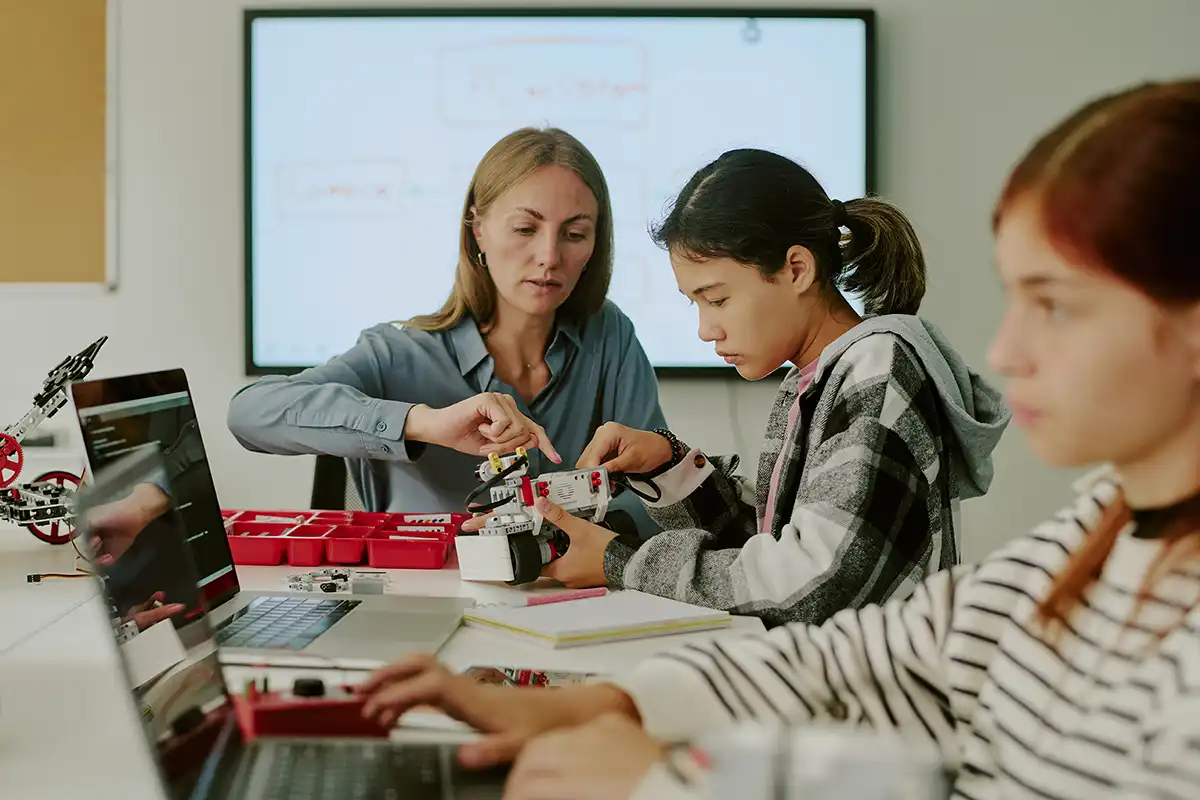
We live in a world where technology is advancing at a dizzying pace and where the professions of the future require more and more creativity, critical thinking and adaptability. In this context, the STEAM education -which integrates Science, Technology, Engineering, Art and Mathematics– has become one of the most comprehensive and valued educational models of the 21st century.
Schools with seal Best Schools in Spain (BSS) have adopted this approach as a fundamental part of their pedagogical project, combining educational innovation with the integral development of each student. Thanks to innovation labs, robotics clubs, interdisciplinary art projects and science fairs, students learn to connect ideas, solve real problems and lead projects in a creative way.
What is STEAM education and why is it transforming the way we learn?
STEAM education goes beyond teaching technical subjects. It is an approach that combines science, technology and creativity with the objective that students:
- learn in an active and practical way,
- connect knowledge from different subjects,
- develop critical thinking,
- prepare for the professional challenges of the future.
Unlike traditional approaches, the STEAM model places the learner at the center of learning. places the learner at the center of learninginviting you to experiment, create, make mistakes, analyze and try again. This methodology promotes autonomy, curiosity and the ability to innovate.
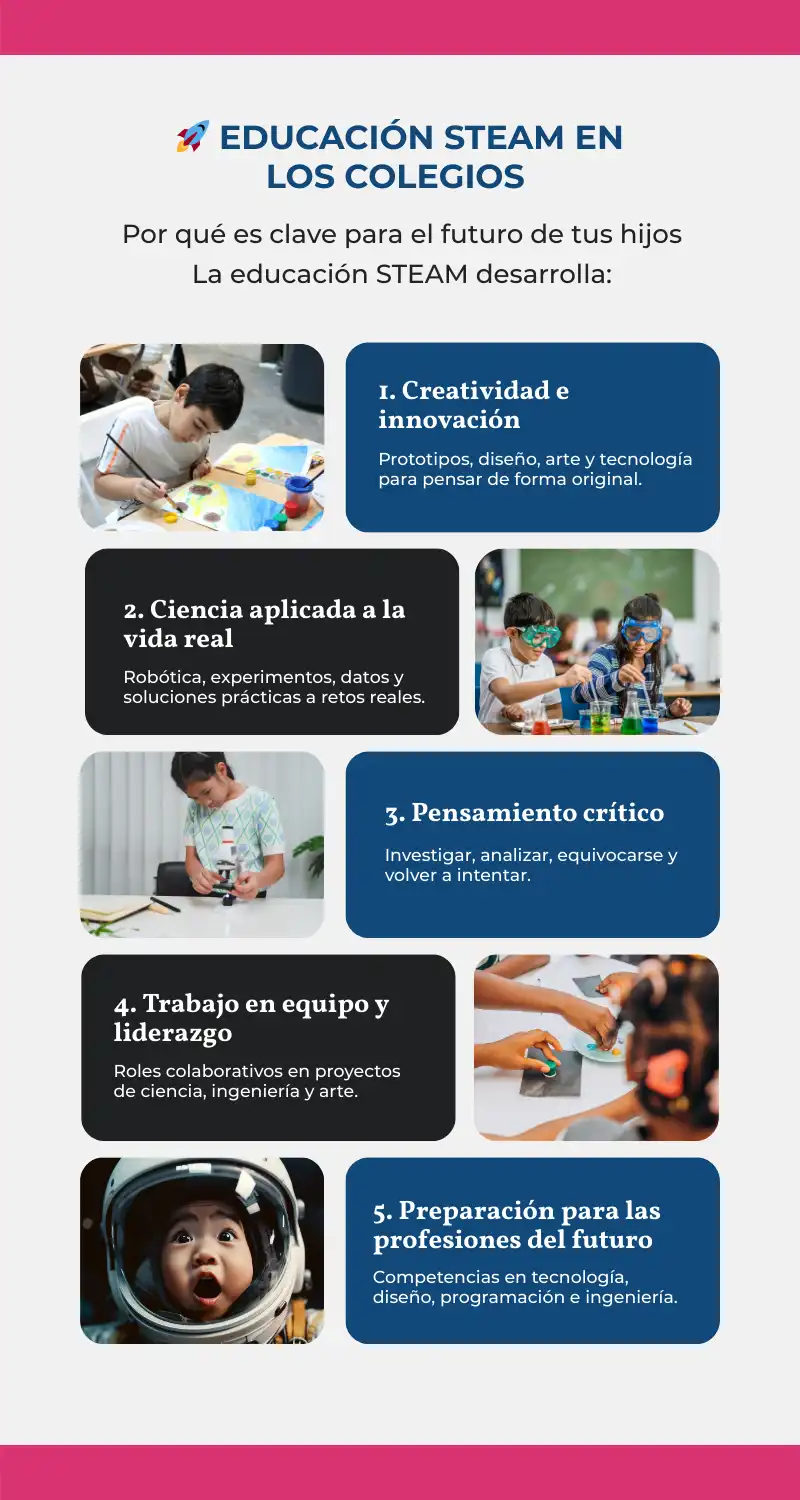
1. Promotes creativity as an engine for learning.
The component A for Art within STEAM is key. Creativity is not only artistic, but the ability to find new and original solutions.
In BSS schools, students:
- design prototypes,
- create models,
- develop audiovisual projects,
- work with creative digital tools.
This marriage of art, design and technology fosters flexible, innovation-oriented thinking.
2. Develops STEM skills applied to real life.
STEAM education helps students understand scientific and mathematical concepts through real-life situations. For example:
- analyze data to solve a challenge,
- program a robot to overcome a circuit,
- design a bridge applying engineering principles,
- measure, experiment and draw your own conclusions.
This hands-on learning makes it easier for students to better understand technical subjects and feel more motivated.
3. Encourages critical thinking and problem solving.
The STEAM model is based on challenges that students must solve through research, analysis and creativity. This strengthens essential skills such as:
- identify a problem,
- hypothesize,
- analyze possible solutions,
- evaluate results,
- learn from mistakes.
These skills are essential in scientific careers, but also in any professional field.
4. Promotes teamwork and leadership
Many STEAM projects are carried out in groups where each student assumes a different role: designer, programmer, coordinator, researcher…
This not only develops social skills, it teaches:
- leadership,
- communication,
- project management,
- real collaboration among peers.
BSS schools encourage these dynamics from an early age to prepare students for collaborative professional environments.
5. Prepares for the professions of the future
According to international studies, the most demanded professions in the next decade will be related to:
- artificial intelligence,
- robotics,
- programming,
- digital design,
- engineering,
- data analysis,
- biotechnology,
- applied creativity.
STEAM education provides a solid foundation in these areas, combining technical and creative skills that open up academic and professional opportunities both in Spain and abroad.
Examples of STEAM education in BSS schools
The Best Schools in Spain stand out for integrating real STEAM projects into their day-to-day work. Some examples are:
- Innovation and technology laboratories: Spaces equipped with 3D printers, robotics kits, visual programming, augmented reality and digital sensors.
- Robotics and programming clubs: Where students design robots, compete in technological challenges and learn to solve problems with computational thinking.
- Interdisciplinary artistic projects: Activities that combine art, design and science, such as:
- creation of interactive installations,
- graphic design applied to technology,
- stop-motion and animation projects,
- mock-ups and creative prototypes.
- Science fairs and STEAM challenges: Events where students present their research, share experiments and develop solutions to real problems.
- Project-based learning (PBL): A key methodology for students to connect science, math, technology and art in concrete challenges.
Conclusion
STEAM education is an investment in your children’s future. It develops creativity, critical thinking, scientific skills and the ability to work in teams, fundamental competencies for a world in constant transformation.
BSS schools integrate this educational model with a practical and innovative approach, preparing students to meet the academic and professional challenges of tomorrow.
If you want to know schools that stand out for their commitment to innovation:
👉 Explore the best private schools by province
👉 Discover our BSS schools
👉 Contact us if you need advice
Frequently Asked Questions
What exactly does STEAM mean?
STEAM is an interdisciplinary educational model that integrates Science, Technology, Engineering, Art and Mathematics through practical and creative projects, encouraging active and meaningful learning.
Why is art important in STEAM education?
Art enhances creativity, innovation and flexible thinking, key skills for solving complex problems, designing original solutions and connecting technical knowledge with creative expression.
At what ages can STEAM education be introduced?
STEAM education can be introduced from kindergarten to high school. At each stage, projects are adapted to the level of development, skills and abilities of the students.
Does STEAM education help improve academic performance?
Yes. By relating theoretical concepts to practical experiences, students better understand science, develop logical thinking and increase their motivation for learning.
What resources do BSS schools use for STEAM work?
BSS schools feature technology labs, engineering materials, educational robotics, digital tools, 3D printers and creative spaces designed for experiential learning.
Do students need to know how to program to learn STEAM?
No. Programming is introduced progressively, starting with simple activities and evolving towards more complex challenges according to age and educational level.
Does STEAM education prepare for the professions of the future?
Yes, STEAM education develops essential technical, creative and cross-cutting skills in sectors such as technology, engineering, design, innovation and emerging professions.