
AI in the classroom is already part of students’ lives: from the tools they use every day to the content they consume on the Internet. In this context, private schools with Best Schools in Spain (BSS) have taken on a fundamental role: to teach students to live with AI in a responsible, ethical and critical way, preparing them for a future in which technology will be an essential part of their academic and professional development.preparing them for a future in which technology will be an essential part of their academic and professional development.
In this article you will discover how AI has been integrated into the educational environment, what competencies BSS schools seek to develop and what best practices are already being implemented in their classrooms to promote a responsible digital education.
AI in the classroom: a tool that is already part of the learning process
AI is not a concept of the future: It is already present in the day-to-day lives of students.
Students use AI applications to study languages, improve their writing, solve exercises or generate creative ideas. That’s why BSS schools are tackling the digital literacy as a basic competence of the 21st century.
It’s not just about incorporating tools: it’s about educating to understand them. educating to understand themIt is about educating to understand them, to know how to use them in a balanced way and to avoid a technological dependence that limits the learner’s autonomy.
Key objectives:
- To understand in a basic way how AI works and its limitations.
- Recognize algorithmic biases and learn to question information.
- Protecting digital digital privacy and manage the online footprint.
- Use AI as a support for creativity, not as a substitute for critical thinking.
- Develop STEAM skills to create, program and innovate.
Why it is essential to teach responsible use of AI
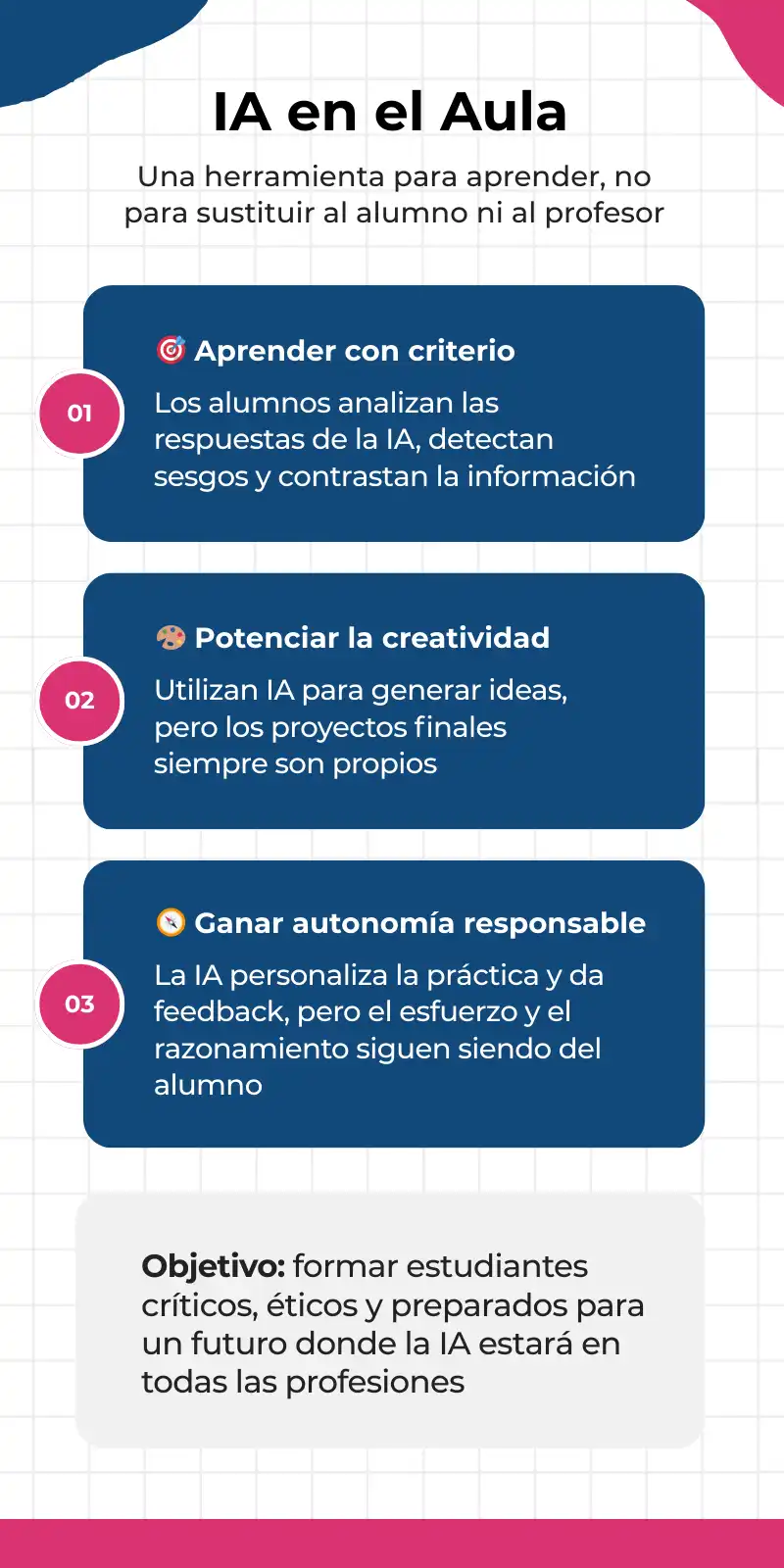
Responsible digital education goes beyond technical learning. BSS schools work three fundamental pillars:
1. Digital ethics and critical thinking
The AI generates answers, but it is up to the learner to evaluate whether they are reliable, complete or correct. For this reason, activities are promoted that encourage:
- critical analysis of AI-generated information;
- understanding of the social and ethical impact of this technology;
- discussions on privacy, copyright, disinformation and transparency.
2. Creativity and innovation
AI tools can enhance creative thinking, provided they are used as a starting point.
Students learn to:
- generate ideas with AI;
- transform them into projects of their own;
- incorporate technology in design and prototyping processes.
3. Autonomy in learning
AI should not replace the learner’s effort, but rather guide it. guide it.
BSS schools teach how to use it for:
- practice in a personalized way;
- receive immediate feedback;
- improve study skills without losing the habit of reasoning on one’s own.
Best practices in BSS schools: how AI is integrated in the classroom
Schools with the Best Schools in Spain seal stand out for their innovative and balanced approach. Among their best practices are:
1. Interdisciplinary projects in programming, robotics and AI.
In Primary and Secondary, students work on projects that combine:
- educational robotics,
- basic programming,
- creation of simple AI models,
- task automation.
These activities help them understand that AI is “not magic,” but a system created by people.
2. Creativity workshops with AI
Students use tools such as text, image or music generators to develop artistic and literary projects.
The objective is for them to learn to manage AI, not to depend on it.
3. Debates and dynamics on digital ethics
The BSS schools include sessions where real cases are analyzed:
- fake news generated with AI,
- biases in algorithms,
- misuse of data,
- impact on digital identity.
These activities help students to build a solid judgment of their own.
4. Pedagogical use of AI tools in classrooms
Teachers introduce AI to personalize learning:
- platforms that adjust activities to the student’s level,
- educational assistants to practice languages or mathematics,
- tools to support reading or comprehension.
Always under supervision and with a formative approach.
5. Continuous teacher training
The success of AI in the classroom also depends on teachers. BSS schools invest in:
- courses on educational AI,
- active methodologies applied to technology,
- strategies for evaluating jobs using AI,
- responsible use protocols.
The ultimate goal: digital literacy for real life
The Best Schools in Spain schools want their students not only to know how to use technology, but also how to understand, question and understand it, question it and create with it..
This comprehensive approach to responsible digital literacy prepares students for a future in which AI will be part of every profession.
The BSS seal guarantees just that: an innovative, ethical education adapted to the challenges of today’s world.
Conclusion
The AI offers enormous educational potentialbut only when it is used judiciously. BSS schools are committed to educating students who are critical, creative and aware of their role as users and future creators of technology.
If you want to discover how these centers work or look for a school that is committed to innovative and responsible education:
👉 Explore the best private schools by province
👉 Discover our BSS schools
👉 Contact us if you need advice

Frequently Asked Questions (FAQs)
How is AI used in the classroom?
Artificial intelligence is used to personalize learning, generate creative ideas, practice skills and support content comprehension. In BSS schools, its use is always supervised by teachers and aligned with clear pedagogical objectives.
What does "responsible use of AI" in education mean?
It means employing AI as a support tool, respecting the privacy of learners, recognizing possible biases and developing critical thinking to evaluate the information it provides.
Do students learn to program artificial intelligence?
In many BSS schools, programming, robotics and computational thinking projects are introduced that allow students to understand the fundamentals of how artificial intelligence works.
Does artificial intelligence replace the teacher?
No. AI does not replace the teacher. It complements teaching, but the teacher remains essential to guide learning, oversee the use of technology, and encourage critical and ethical thinking.
How is student privacy protected when using AI?
BSS schools apply strict digital security protocols and teach students how to manage their online identity, digital footprint and responsible use of technology tools.
Does AI affect school performance?
When used correctly, AI can enhance motivation, provide personalized practice and support understanding of content. However, it should never replace personal effort and active learner learning.
Why is it important to teach digital ethics in relation to AI?
Because artificial intelligence influences social, cultural and personal decisions. Understanding its risks, limitations and responsibilities is key to forming critical and responsible citizens.