
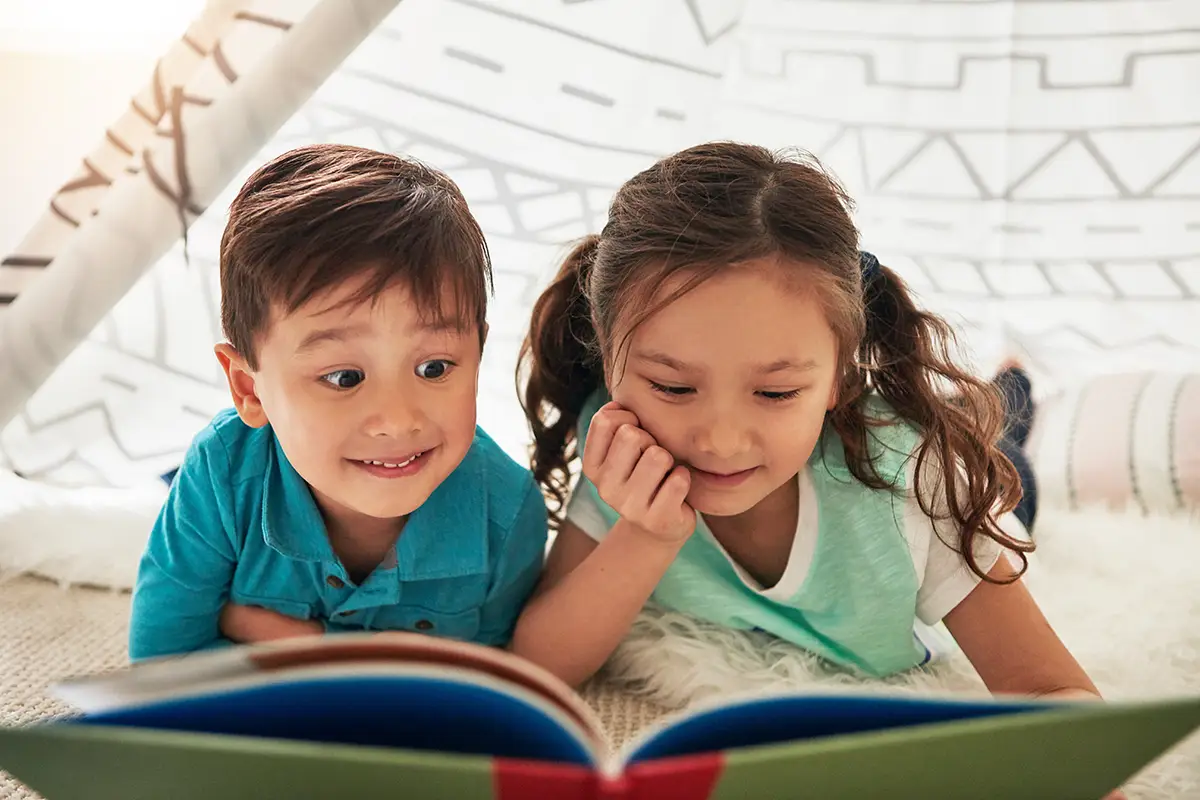
Most children are not born hating books. What happens is that they associate reading with obligation before discovering the pleasure it can generate. This is what changes when the reading habit is built in children in the right way.
For years the same idea has been repeated: reading is important. The problem is that many children grow up associating reading with obligation, homework or school performance, and not with enjoyment, curiosity or discovery. And that’s where the real challenge begins.
Because the habit of reading in children does not appear by itself. It is built. The difference between a child who reads naturally and one who rejects any book rarely has to do with intelligence. It has much more to do with the environment, with how reading is presented and with the emotional experiences that surround it.
“A child who understands well what he reads learns better about virtually everything. Reading is not just one skill: it is the multiplier of all the others.”
Why the reading habit in children is much more important than it may seem
Reading doesn’t just improve spelling or vocabulary. Children who read frequently develop cognitive and emotional advantages that transfer to all areas of their lives:
| Ability | How reading improves | Classroom Impact |
|---|---|---|
| Reading comprehension | Trains decoding of complex texts | Improved performance in all subjects |
| Sustained attention | Habituates the brain to maintain focus for longer periods of time | Less distraction in class, better concentration |
| Critical thinking | Exposure to complex arguments, perspectives and dilemmas | Enhanced analytical and debating skills |
| Vocabulary and expression | Expand passive and active lexicon in a natural way | Improved oral and written expression in all subjects |
| Empathy | Allows to put oneself in the place of different characters | Better social relations, less conflicts |
| Imagination | Activates mental construction of scenarios without visual stimulus | Increased creativity in problem solving |
The most common mistake: turning reading into an obligation
Many parents, with the best of intentions, end up doing exactly the opposite of what they are looking for. Forcing reading, imposing rigid timelines, or using reading as an extra chore often leads to lasting rejection.
⚠ The mechanism of rejection
The problem is not the book. It is the emotional experience associated with it. When a child feels that reading is an obligation, a constant correction, or a test, the motivation disappears. And once that negative association is formed, it is difficult to reverse without a conscious change in approach.
| Habit-building approach | Approach that generates rejection |
|---|---|
| Pleasant reading time before bedtime | “You have to read 30 minutes before dinner.” |
| Child chooses the book | Required summer reading list |
| Discuss what you have read | Reading card or written summary required |
| Adults reading at home | “Put down the cell phone and start reading.” |
| Correct only when necessary | Interrupt each sentence to mark errors |
The 10 tips that really work
These are not gimmicks or magic formulas. They are concrete strategies that work because they respect how children really learn and are motivated.
1. Create a fixed reading time each day
Habits work best with context and repetition. At first, 10 to 15 minutes a day is enough. The key is not the number of minutes, but that it always occurs at the same time until it becomes automatic.
2. Let them choose their own books
A child starts reading more when he finds something that connects with his real interests. The initial goal is not for him to read great classics, but for him to discover that reading can be enjoyable.
Comic book – Adventure – Mystery – Sports – Animals – Manga
3. Do not constantly correct while reading
If every sentence is stopped to correct pronunciation or mark errors, reading goes from being fluent to being tense. Especially at early ages, maintaining interest is more important than technical perfection.
Fluency improves on its own with practice. Motivation, if broken, is not easily regained.
4. Set a real example at home
Habits are more contagious by observation than by instructions. It is not necessary to set up a perfect scene: it is enough that the books are part of the everyday landscape.
Visible books at home – Adults reading – Talking about what you read – Giving books as a gift – Book gifts
5. Adapt books to each stage
A common mistake is to offer books that are too difficult “to make progress”. The result is often frustration. Reading should generate a manageable challenge, not exhaustion. We leave you a post where we recommend the best books for children according to their age.
6. Relate reading with pleasure, not with reward or punishment.
Reading should not be used as a punishment, an academic obligation or a bargaining chip. The more natural the experience, the easier it will be to consolidate the habit.
At the beach or on vacation – During a trip – In a coffee shop – Reading together on the couch
7. Talk about what they read without turning it into a test.
Reading should connect with emotions and thought, not just memory. Instead of evaluating, converse.
| Instead of… | Try with… |
|---|---|
| “What did you learn?” | “Which part did you like the most?” |
| “Who was the protagonist?” | “What would you have done in his place?” |
| “What does this mean?” | “Did you like that character?” |
8. Reduce constant overstimulation
Many children do not refuse to read because they don’t like it. They reject any activity that requires sustained attention. Reading competes against TikTok, YouTube and hyper-stimulating video games.
Creating a reading habit in children also involves creating mental space. Without moments of calm, reading has nowhere to enter. It is not a problem of the book: it is a problem of attention span trained for immediacy.
9. Visit bookstores and libraries
The relationship with books changes when they leave the school context. Going to a bookstore and being able to explore without pressure generates natural curiosity.
Choosing a book for pure pleasure, without anyone evaluating it or giving it a grade, creates a different emotional association. Well-designed children’s libraries make books enjoyable and free.
10. Respect the individual pace of each child
Not all children develop the reading habit at the same time. There are children who start late and end up being great readers. Comparing with siblings or peers only generates blockage.
The goal is not for him to read faster or more than others. It is to keep the experience positive enough so that by the time she finds the right book, there is already a healthy relationship with reading.
What type of books work best at each stage
Children – Pre-reader
- Visual books with little text
- Repetition and rhythm
- Short and predictable stories
- Shared reading with adult
- Tactile and pop-up books
Primary – Early Reader
- Sagas (generate anticipation)
- Adventures and humor
- Accessible mystery
- Comics and graphic novels
- Books on own topics
Secondary – Independent Reader
- Identity and self-knowledge
- Emotions and relationships
- Real conflicts and dilemmas
- Dystopias and science fiction
- Non-fiction about their interests
What schools that encourage reading habits in children do differently
The best educational models understand something important: reading well is not about accumulating books, but about developing comprehension, thinking and curiosity. The schools recognized by Best Schools in Spain work with reading from a broader perspective than traditional reading comprehension.
Active book clubs
Interdisciplinary projects
Active, not decorative, libraries
Critical reading and oral discussion
The reading habit is not imposed: it is built up
Most children are not born hating to read. What usually happens is that they associate reading with pressure or obligation before discovering the pleasure it can generate.
For this reason, creating a reading habit in children has less to do with demanding and much more to do with accompanying. Small moments repeated over time end up building something that goes far beyond books: a child capable of learning, imagining and understanding the world more deeply.
“It’s not about getting him to read more. It’s about you discovering that reading can be enjoyable. The rest comes on its own.”
Frequently asked questions about reading habits in children
How to encourage reading in children who do not want to read?
How much should a child read per day to create a habit?
There is no exact figure. For habit building, 10 to 20 minutes a day consistently works better than occasional long sessions. Consistency matters more than quantity: a child who reads 15 minutes every day develops the habit much sooner than one who reads for two hours on Sunday.
At what age can you start to create a reading habit?
From a very young age, even before they know how to read. Listening to stories, handling books and relating them to positive experiences (the adult’s voice, the warmth of the moment, curiosity) helps build the habit of reading in future children. Children from 3 to 6 years old especially benefit from shared reading, which generates affective bonds with the act of reading.
What errors most hinder the reading habit in children?
Why does reading have such an influence on school performance?
What books are best for children ages 7 to 10?
At this age, sagas (because they generate anticipation for the next volume), adventures with humor, accessible mysteries, and books on topics of interest to the child. Graphic novels and comics are also valid: the important thing is that the difficulty generates a manageable challenge and not frustration.
Are you looking for a school that builds readers, not just students who read?
Schools recognized by Best Schools in Spain integrate reading as a tool for thinking, not only as academic content. Reading clubs, interdisciplinary projects and active libraries form readers for life.