
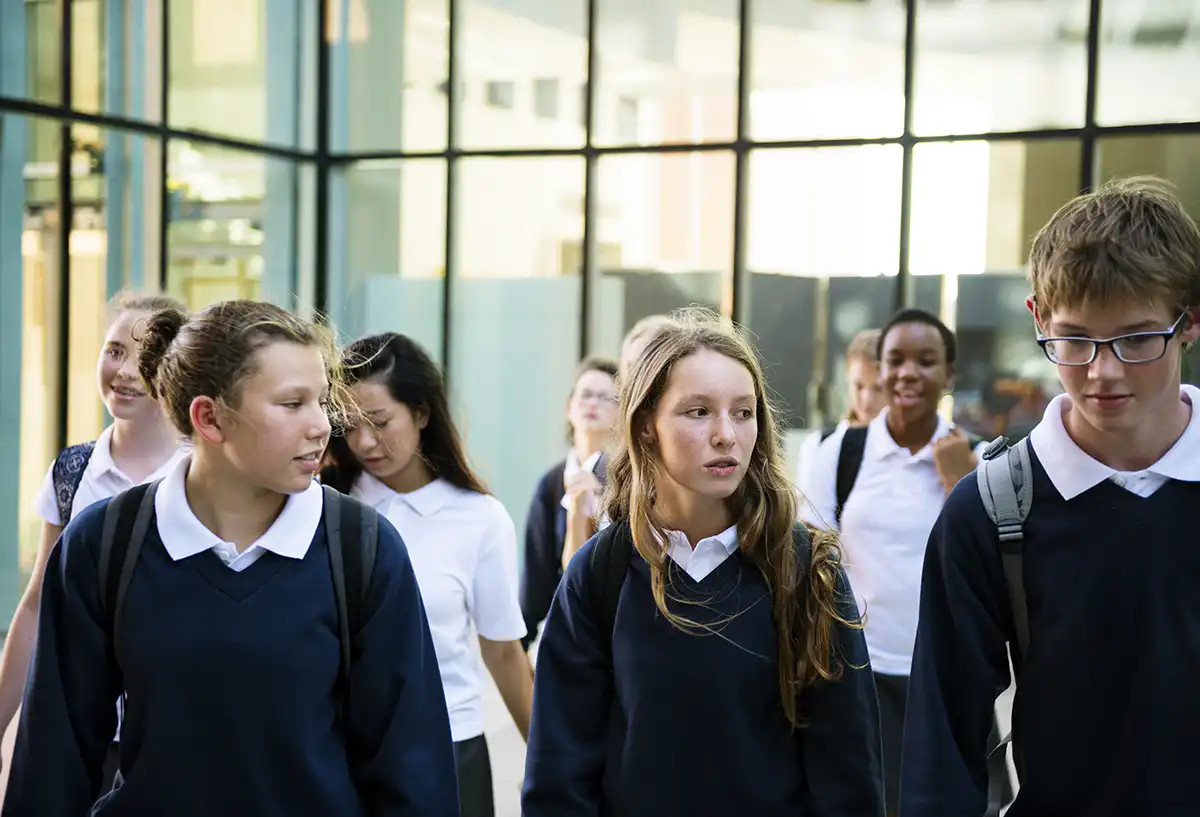
Choosing an international school in Spain for your children is one of the most important decisions in family life. More and more families – both Spanish and international – are opting for an international school in Spain. international schools in SpainThe schools offer a global, multilingual and future-oriented education. These schools combine high academic standards, innovative methodologies and a personalized accompaniment that prepares students to study and work anywhere in the world.
Schools with seal Best Schools in Spain (BSS) schools stand out in this area by offering international curricula such as the International Baccalaureate (IB)the British curriculum or the American curriculumThe IB curriculum, along with a multicultural environment that fosters critical thinking, autonomy and a global mindset.
Here are 10 key reasons to choose an international school in Spain.
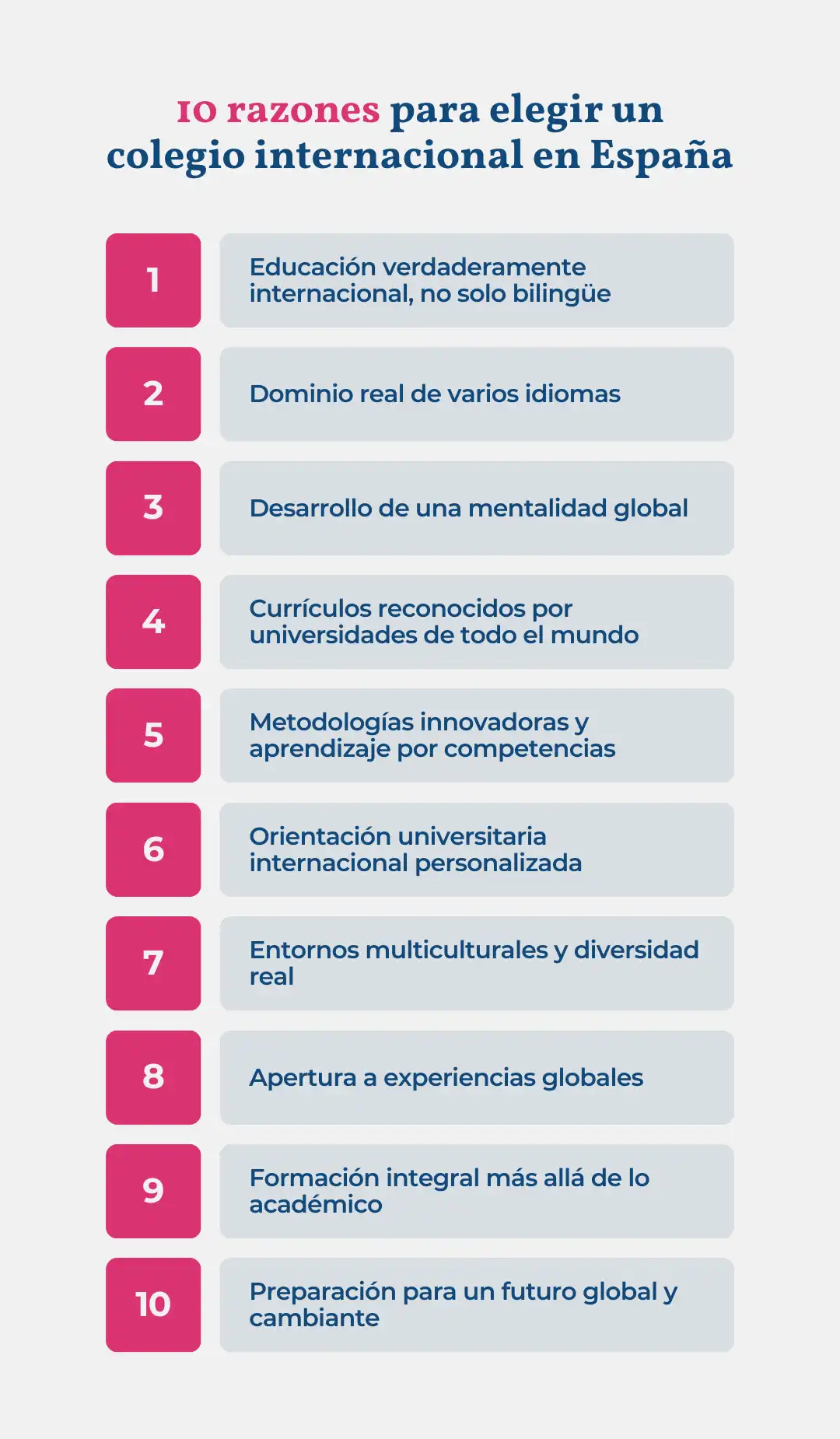
1. Truly international education, not just bilingual
Unlike many traditional bilingual schools, international schools offer:
- globally recognized curricula (IB, British, American),
- competency-based learning methodologies,
- continuous and authentic evaluation,
- intercultural approach in all areas.
This allows students to experience education from a global perspective, with content and pedagogical strategies adapted to a multicultural world.
2. Real command of several languages
Bilingualism is a basic pillar of international education, but here it goes beyond that:
- English as the main academic language,
- study of one or two additional languages (French, German, Chinese, etc.),
- real immersion environments thanks to students and teachers of multiple nationalities.
BSS schools stand out for their commitment to advanced language programs and official certificates that open doors at universities around the world.
3. Development of a global mindset
One of the greatest benefits of international education is the intercultural approach. Students learn to:
- understand different perspectives,
- communicate with people from diverse contexts,
- working in multicultural teams,
- approaching problems from a global perspective.
This type of mindset is key for future professionals in an increasingly interconnected world.
4. Curricula recognized by universities worldwide
International schools in Spain offer educational systems such as:
International Baccalaureate (IB)
British Curriculum (IGCSE + A-Levels)
- Recognized in more than 150 countries.
- Valued by universities for their demand for critical thinking, research and personal autonomy.
American curriculum
- Flexible, competency-based and learning-by-doing oriented.
- Includes programs such as AP (Advanced Placement) for access to U.S. universities.
Many BSS schools offer one or more of these programs, allowing for full educational continuity.
5. Innovative methodologies and competency-based learning
International schools give priority to:
- interdisciplinary projects,
- critical thinking,
- problem solving,
- debate and communication,
- creativity,
- guided research.
Learning is more active and practical, encouraging the student to be the protagonist of his or her own process.
6. Personalized international university orientation
One of the great strengths of the BSS colleges is their universities guidance officea professional accompaniment that helps students:
- identify interests and skills,
- choose universities in Spain and abroad,
- preparing for official exams and interviews,
- adapt your academic portfolio.
This preparation makes the difference in competitive university access processes.
7. Multicultural environments and real diversity
Students of dozens of nationalities live together in international schools.
This enriches the daily life of the students and facilitates:
- tolerance,
- empathy,
- adaptability,
- open thinking.
Many BSS schools have balanced ratios that encourage authentic immersion without losing the connection to Spanish culture.
8. Openness to global experiences
These schools offer unique opportunities such as:
- academic exchanges,
- cultural and scientific trips,
- international leadership programs,
- participation in student conferences (such as MUN – Model United Nations – Model United Nations). Model United Nations).
All of this contributes to the personal, emotional and social development of the student.
9. Comprehensive training beyond academics
International education seeks not only academic results, but to form complete people. BSS schools empower:
- emotional education,
- regular sport,
- music, arts and creativity,
- digital thinking,
- leadership skills.
This balanced approach prepares the student to face challenges in and out of the classroom.
10. Preparing for a global and changing future
Students who go through an international school acquire:
- digital competencies,
- critical thinking,
- communication skills,
- autonomy in decision making,
- global vision to adapt to international university and professional environments.
In a world where international mobility is increasing, this training is a huge competitive advantage.

Examples of BSS schools with international curricula
The Best Schools in Spain offer a variety of international programs, such as:
- Agora Madrid International School
- San Patricio School Madrid
- Los Sauces School La Moraleja
- Los Sauces School Torrelodones
- Arturo Soria School
- Mirabal International School
- Virgen de Europa International School
- IDEO School
- SEK International School El Castillo
- Brains International School La Moraleja
- Brains Arturo Soria
- Alameda de Osuna International School
- Hastings School
- King’s College Soto
- Madrid Santa María Foundation School
- SEK International School Ciudalcampo
- Liceo Sorolla International School
- Arcángel International School
- SEK International School Santa Isabel
- Colegio “Estudio”
- King’s Infant School Chamartín
- King’s College La Moraleja
These centers demonstrate the BSS commitment to educational excellence and global training.
Conclusion
Choosing an international school in Spain means opting for a high quality, future-oriented education with international recognition. BSS schools combine global curricula, a multicultural environment and personalized attention that prepares students to study at the best universities in the world.
If you are looking for the ideal school for your family:
👉 Explore the best private schools by province
👉 Discover our BSS schools
👉 Contact us if you need advice
Frequently Asked Questions (FAQs)
1. What differentiates an international school from a bilingual school in Spain?
An international school provides a globally recognized educational curriculum, such as the International Baccalaureate (IB), British or American. In contrast, a bilingual school usually follows the Spanish educational system, reinforcing language learning, but without a full international academic program.
What are the advantages of studying the International Baccalaureate (IB)?
The International Baccalaureate (IB) encourages critical thinking, research, student autonomy and a global vision of learning. In addition, it is a highly valued qualification by universities around the world, which facilitates access to higher international studies.
Does my child need to be a native English speaker to study at an international school?
No. Most international schools have language support programs that help students adapt progressively to the language, regardless of their initial level of English.
Are international schools only for foreign families?
No. More and more Spanish families are choosing international schools because of their global focus, innovative methodology and the international university opportunities they offer their children.
5. Can I transfer my child to an international school in Junior or Senior High School?
Yes, it is possible to change at these stages. However, it is recommended to do so before the Baccalaureate, as the adaptation to the international curriculum is easier and the student can take better advantage of the academic program.
6. Do international schools have a heavier academic load?
Not necessarily. Their approach is different: they prioritize more practical, competency and critical thinking-oriented learning, as opposed to traditional memorization.
7. Which international curriculum is better: IB, British or American?
There is no absolute “best” one. The choice depends on the student’s objectives, their way of learning and the university destination. The IB, British and American curricula are excellent and internationally recognized.