

International schools in Spain is one of the most common searches among families looking for a global education, especially those with international projection or who value an educational model different from the traditional one. But what really defines an international school, how does it differ from a bilingual school, and what criteria should be analyzed before making such an important decision?
In this article we explain in a clear way what international schools in Spain are what curricula they offer, what type of student fits best in this educational model and how to identify quality centers, such as those with the seal Best Schools in Spain (BSS).
What is an international school (and what is not)?
An international school is not simply a school where classes are taught in English. Its main difference is in the complete educational project which usually includes:
- a internationally recognized curriculum,
- a competency-based methodology,
- a real multicultural environment,
- a clear international university orientation.
This distinguishes them from many traditional bilingual schools, which follow the national curriculum and reinforce the language, but do not offer a complete international academic education.
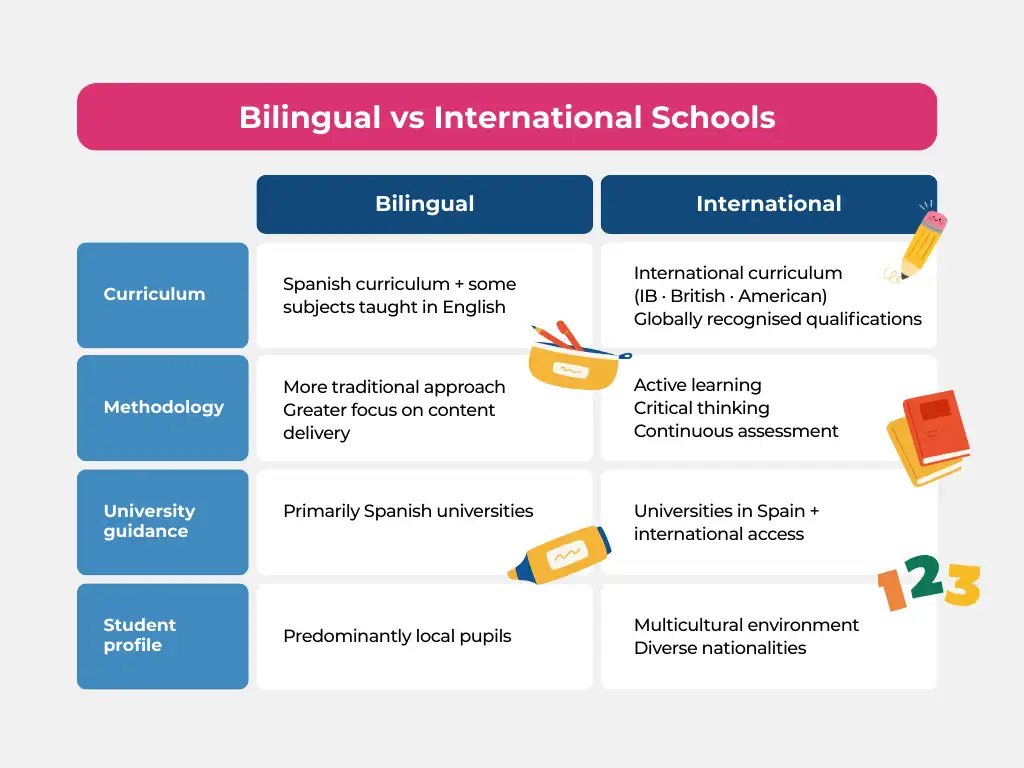
International schools vs. bilingual schools: key differences
| Aspect | Bilingual schools | International schools |
|---|---|---|
| Curriculum | Spanish curriculum with some subjects in English. | International curriculum (IB, British or American) with global recognition. |
| Methodology | More traditional approach, focused on content and memorization. | Active learning, critical thinking and continuous evaluation. |
| University Orientation | Mainly oriented to the Spanish university system. | Preparation for universities in Spain and abroad. |
| Student profile | Mostly local students. | Multicultural student body, with a diversity of nationalities. |
Main international curricula in Spain
International schools in Spain usually offer one or more of these educational systems:
the International Baccalaureate (IB)
It is one of the most recognized curricula in the world. It stands out for:
- development of critical thinking,
- research focus,
- interdisciplinary learning,
- high valuation by international universities.
It is ideal for students with good autonomy and organizational skills.
British curriculum
It includes stages such as IGCSE and A-Levels. It is characterized by:
- clear academic structure,
- strong background in science and mathematics,
- external standardized evaluation.
Very suitable for families with ties to the Anglo-Saxon system.
American curriculum
It offers greater flexibility and a more personalized approach. It stands out for:
- continuous evaluation,
- student’s academic and personal development,
- programs such as AP (Advanced Placement).
It is a good option for students who value a more practical and transversal learning.
What type of student fits best in an international school
International schools tend to work especially well for students who:
- are curious and open-minded,
- adapt well to multicultural environments,
- value active learning over memorization,
- have international projection or plans to study outside Spain.
They are also an excellent option for expatriate or internationally mobile families.
How to choose the right international school
Choosing a school should not be based solely on rankings or facilities. These are the key criteria to be analyzed:
Educational project
It must be well defined and aligned with family values.
Language and linguistic support
It is important to know:
- in which language the classes are taught,
- if there is support for non-native students,
- how Spanish is progressively integrated.
3. University Orientation
A good international school offers personalized counseling for access to national and international universities.
4. Multicultural environment
The real diversity in the classroom favors the adaptation and social development of the student.
5. Accompaniment and personalized attention
Tutoring, individual follow-up and fluid communication with families are fundamental.
The Best Schools in Spain (BSS) seal of approval as a guarantee of quality.
The seal Best Schools in Spain identifies private schools that stand out for:
- proven academic excellence,
- strong international educational projects,
- methodological innovation,
- high-level university orientation,
- commitment to the integral formation of the student.
For families, the BSS seal acts as a guarantee of confidence guarantee of trust similar to other quality seals in premium sectors: certifies that the school meets exacting standards aligned with a forward-looking education.
Conclusion
International schools in Spain offer a global, flexible and future-oriented education. Understanding their differences compared to bilingual schools, knowing the curricula available and analyzing the educational project with criteria is key to making the best decision.
The schools with the BSS seal represent a selection of schools that combine academic quality, international projection and personalized support, making it easier for families to make an informed and safe choice.
👉 Explore the best private schools by province
👉 Discover our BSS schools
👉 Contact us if you need advice

Examples of international schools in Spain that are part of BSS
The Best Schools in Spain offer a variety of international programs, such as:
- Agora Madrid International School
- San Patricio School Madrid
- Los Sauces School La Moraleja
- Los Sauces School Torrelodones
- Arturo Soria School
- Mirabal International School
- Virgen de Europa International School
- IDEO School
- SEK International School El Castillo
- Brains International School La Moraleja
- Brains Arturo Soria
- Alameda de Osuna International School
- Hastings School
- King’s College Soto
- Madrid Santa María Foundation School
- SEK International School Ciudalcampo
- Liceo Sorolla International School
- Arcángel International School
- SEK International School Santa Isabel
- Colegio “Estudio”
- King’s Infant School Chamartín
- King’s College La Moraleja
These centers demonstrate the BSS commitment to educational excellence and global training.
Frequently Asked Questions
What is the difference between an international school and a bilingual school?
The main difference is the academic curriculum. International schools follow globally recognized educational programs (such as IB, British or American), while bilingual schools teach the national curriculum reinforcing the language, but without a full international program.
Which international curriculum is better: IB, British or American?
There is no universally “best” curriculum. The choice depends on the student’s profile, learning style and university objectives. The International Baccalaureate (IB), the British curriculum and the American curriculum are high quality and internationally recognized options.
Are international schools only for foreign families?
No. More and more Spanish families are choosing international schools for their global approach, methodology and orientation towards national and international universities.
Is it necessary for the student to have a high level of English?
Not always. Many international schools offer language support programs that facilitate progressive adaptation to the language.
How does the BSS seal help families?
The Best Schools in Spain (BSS) seal identifies trustworthy schools with proven educational projects, academic excellence and international projection, helping families in their decision-making process.
Can I change to an international school in Junior or Senior High School?
Yes, it is possible to change at these stages. However, it is advisable to assess the timing and curriculum to facilitate academic adaptation and ensure educational continuity.